How to read prediction market odds
On this page
Every market on Predictions shows a chance: a percentage that is really a price. This article explains how to read it, in the order you meet the numbers, so you can tell a firm price from a thin guess.
#A price is a chance
A prediction market trades contracts that pay $1 if something happens. Its price is the market's chance: a contract at 62¢ means traders give it 62%.
The number Predictions shows is the midpoint between the best bid (what buyers offer) and the best offer (what sellers ask), or the last trade when the two are more than ten cents apart. It is read from the venue every few minutes, so it can be a few minutes behind.
For a question with many answers, such as who wins a title, the chances are scaled to add up to 100%. A chance under half a percent shows as <1% and one above 99.5% shows as >99%.
#Read a market card
Markets appear as cards on the Predictions page, in topics, in search and in lists. Each card shows the same parts.
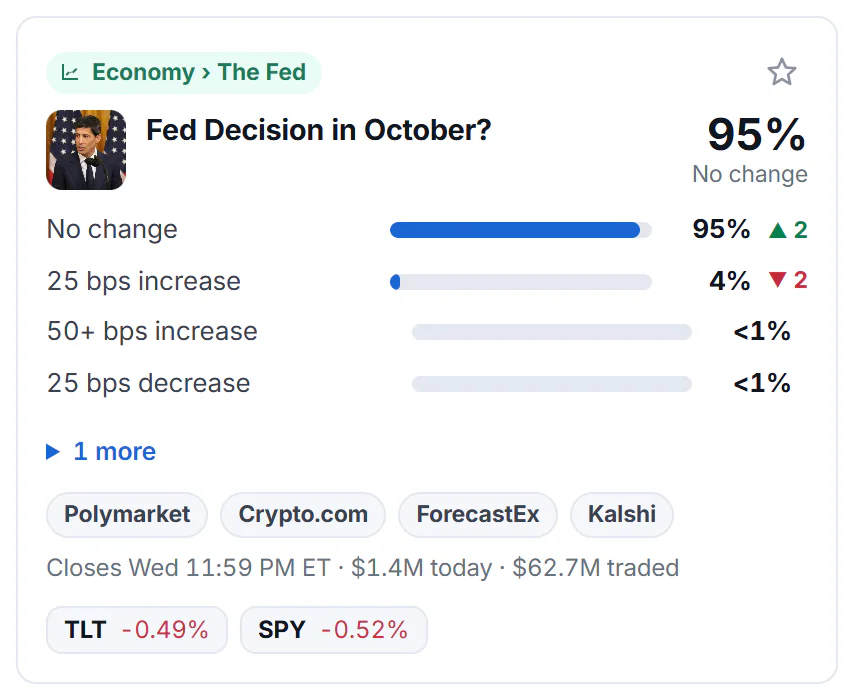
One market card. The leading answer is the one with the highest chance; the other answers sit below it as bars.
- 1Topic
- 2Follow star
- 3Leading answer and its chance
- 4Every answer, with its move today
- 5Venues that list it
- 6When it is decided, and the money
- The topic chip says what the market is about, for example Economy › The Fed. Select it to see every market in that topic.
- The star follows the market. See Follow markets.
- The big number is the leading answer and its chance.
- Each answer has a bar and its chance. The arrow and number beside it, such as ▲ 2 or ▼ 2, are how many percentage points the chance moved in the last day. Rest the pointer on one to read it in words. When there are more answers than fit, a more line unfolds the rest.
- The venue chips name each venue that lists the question. Select one to open the market on that venue in a new tab. A chip marked Kalshi 62% carries that venue's own number.
- The last line says when the market is decided and how much money has traded, such as Closes Wed 11:59 PM ET · $1.4M today · $62.7M traded. Times are Eastern.
Under some cards, small chips such as SPY or BTC-USD show the price the market is about, with today's change. Select one to open it in 4Search Finance. See Stocks, rates and coins that markets are about.
#Different questions show differently
- Yes or no. One big number and a bar: the chance that it happens.
- Which one wins. A bar for each answer, the likeliest first. Questions about dates list the dates in order.
- A game. A scoreboard with each side's chance side by side and the draw in the middle. See Browse markets by topic.
- How high or how low a number goes. Questions such as "S&P close price end of 2026?" are asked as a ladder of prices ("above 4.25%, above 4.50% ..."). Together the prices give a whole spread of outcomes. The page shows the median, the level where traders see an even chance either way, and the middle half, the range between the 25th and 75th percentiles.
- Will it reach a price. Questions such as "What price will Bitcoin hit in October?" list levels with Reaches and Falls to and the chance of each. The Already reached line lists the levels that have been touched, and the headline reads like "high with an even chance $84,129".
#The money numbers
| Label | What it is |
|---|---|
| Today | Dollars traded in the last 24 hours |
| Traded | Dollars traded since the market opened |
| This week | Dollars traded in the last 7 days |
| At stake | What is riding on the outcome right now (open interest, the contracts traders hold) |
Kalshi and ForecastEx count their money in contracts, so Predictions shows an estimate: contracts at their price. Polymarket and Crypto.com report dollars. The note under the odds on each page says which venues' money is estimated this way.
Money is a clue to how much to trust a number. A market with little money is thin, and one trade can move its price. Predictions leaves thin markets out of the biggest moves.
#Bid, ask and what a dollar pays
A market's own page has an Every outcome table with the figures traders see.
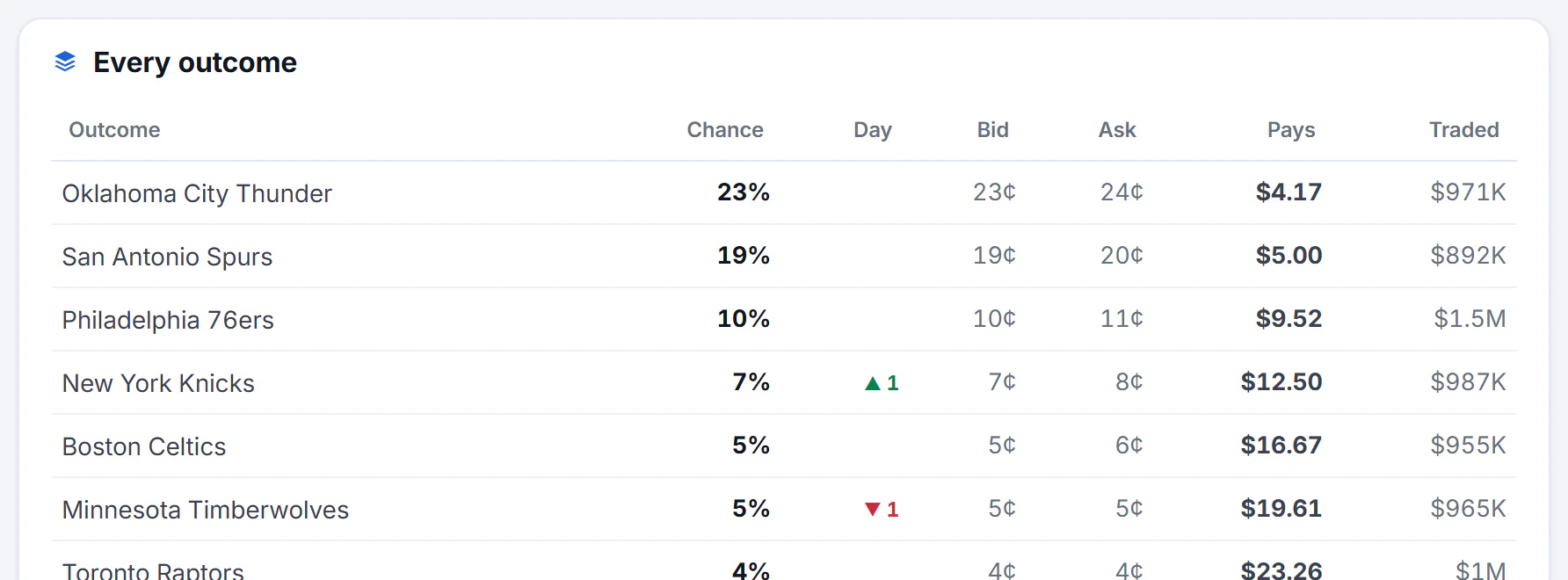
Part of the Every outcome table. Select a column heading to sort by it.
- 1Chance
- 2Move today
- 3Bid
- 4Ask
- 5What $1 pays
- Chance is the price read as a percentage. Once a market has settled, this column reads Last odds.
- Day is how far it moved in the last day, in points.
- Bid is the best price a buyer of "Yes" offers, and Ask is the best price a seller of "Yes" asks. The gap between them is the spread; a wide one usually means few traders.
- Pays is what a $1 stake returns if that outcome happens, at the ask and before any fees. At an ask of 24¢ it shows $4.17. Rest the pointer on it to see the same odds as American, decimal and fractional odds.
- Traded is the money traded on that outcome, or Contracts on venues that count contracts.
#When a market closes and settles
- Closes is when trading ends. Starts and In play appear on games.
- A market that has closed but not yet been decided says Closed, awaiting its result on its page.
- Settled means the venue has decided the result. The page then shows what happened with a check mark, and the odds as they stood before it closed.
- An Upset is a result that traders gave under 30% the day before.
- A market on Polymarket whose listed end date has passed can stay open while its result is awaited. Its card then says Result pending, and its page shows the listed end separately. Polymarket's end dates are estimates.
See New and resolved markets and Track Record.
#Common questions
Does 70% mean it will happen?
No. It means traders pay about 70¢ for a $1 contract. Over many questions priced at 70%, a well-calibrated market sees about seven in ten happen, and Track Record shows how that has held up here. A 70% question still fails three times in ten.
Why does the same question show different numbers on two venues?
Each venue has its own traders, its own rules and its own moment of last trade. Predictions shows every venue's number and never averages them. See Compare venues.
Is At stake the same as Traded?
No. Traded is everything that has changed hands since the market opened. At stake is what traders hold right now, so it can be much smaller than the total traded.
What do the arrows mean?
▲ and ▼ show how far a chance moved, in percentage points, over the last day (or the last week on the weekly lists). A green arrow up is a rise and a red arrow down is a fall.
What is a contract?
It is what you buy on the venue: a promise that pays $1 if the outcome happens and nothing if it does not. Predictions does not sell contracts.